ABAX Vision AI: Integrated dash cams for a safer fleet
ABAX Vision AI: Integrated dash cams for a safer fleet
Tachograph symbols explained: Complete UK guide for 2026
Learn what every tachograph symbol means. A complete UK guide to driver activity icons, smart tachograph 2 pictograms and compliance.


Contents
What is a tachograph?Why do tachograph symbols matter?The 4 core tachograph symbols every driver should knowSmart Tachograph 2 symbols: What's new for 2026Other tachograph symbols you might seeCommon mistakes drivers make with tachograph symbolsEssential Tachograph legal requirementsWhat Fleet Managers should do with tachograph dataHow ABAX Tachograph helps you stay compliantImagine this scenario: a driver pulls into a service area for a well-earned break after a long stretch on the motorway. They turn off the engine but mistakenly select the wrong tachograph symbol on the device. A few weeks later, the operator receives a heavy fine following a Driver and Vehicle Standards Agency (DVSA) roadside check. The records simply don’t add up, and what was an honest mistake quickly turns into a costly compliance headache.
Understanding tachograph symbols is not just a matter of passing a test; it is an everyday operational requirement that keeps drivers safe and businesses compliant. Whether you are a veteran HGV driver, a newly qualified van operator, or a Fleet Manager overseeing compliance, you must know what each of these icons means.
In this easy to understand UK guide for 2026, we cover the digital tachograph symbols every driver must know, the new pictograms introduced by the upcoming Smart Tachograph 2 (SMT2) mandate, and exactly what transport managers should be doing with the data to avoid penalties.
Use our handy LCV tachograph checklist to see if your fleet is ready
What is a tachograph?
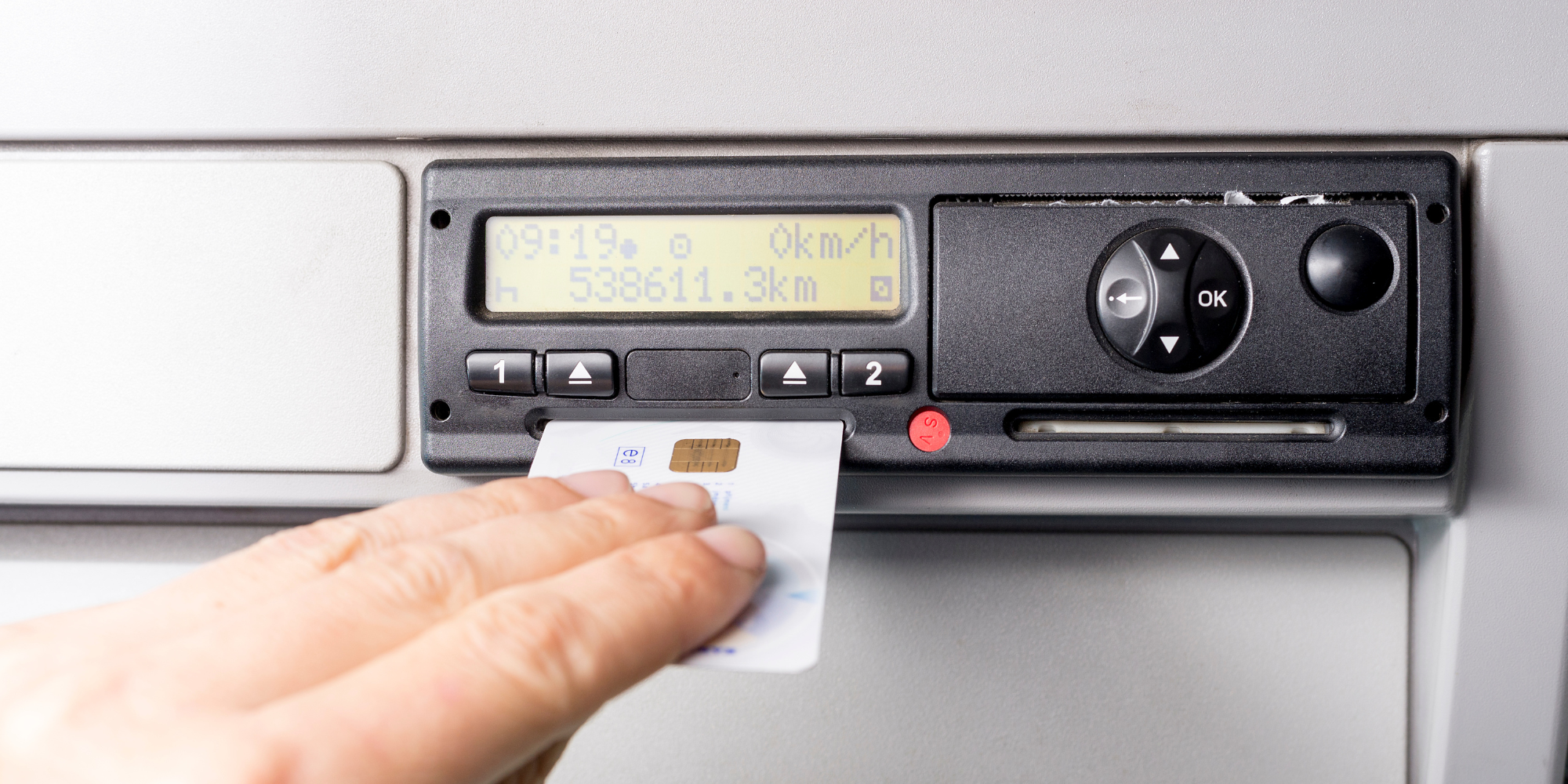
A tachograph is a device fitted to a vehicle that automatically records its speed and distance, alongside the driver's activity. The primary purpose of a tachograph is to ensure that drivers and employers comply with the strict rules governing drivers' hours. By recording this data accurately, the industry can combat driver fatigue and guarantee safer roads for everyone.
Why do tachograph symbols matter?
Tacho symbols matter because the four core driver activity symbols are set in law under Regulation 165/2014. This legislation ensures a universal standard across the UK and the EU. Every tachograph manufacturer - whether VDO, Stoneridge, or EFAS - uses the exact same tachograph symbols and meanings. When a driver correctly logs their status using these icons, they provide an indisputable, legally binding record of their working day.
According to the RoSPA Driver Fatigue Factsheet (March 2024), fatigue is a silent killer on our roads, where "may be a contributory factor in up to 20 per cent of road collisions, and up to one quarter of fatal and serious collisions." Even more alarmingly, approximately 40% of all sleep-related collisions involve commercial drivers.
By recording data accurately, the transport industry can combat driver fatigue, protect professional drivers, and guarantee safer roads for everyone.
The 4 core tachograph symbols every driver should know
There are four legally established tachograph symbols used universally across the UK and EU, and every commercial driver is legally required to know and use them correctly.


1. Driving (steering wheel)
The Driving symbol is represented by a steering wheel. This symbol records the time a driver spends actively controlling the vehicle while the engine is running. In all modern digital and smart tachographs, this symbol is automatically selected the moment the vehicle begins to move. You do not need to set it manually; the vehicle unit will immediately start logging your driving time to ensure you do not exceed your legal limits.
2. Other work (crossed hammers)
Depicted by a pair of crossed hammers, the Other work symbol covers any time you are working, but not driving. This includes activities such as loading or unloading the vehicle, performing daily vehicle defect checks, vehicle maintenance, or assisting passengers.
Unlike the driving symbol, this must often be selected manually when the vehicle stops, though some modern devices will automatically default to Other work once the ignition is turned off.
3. Availability / POA (square with diagonal line)
The Availability symbol - sometimes referred to as Period of Availability (POA) - is shown as a square crossed by a diagonal line. This is used for periods when the driver is not required to remain at their workstation but must be available to answer calls to start or resume driving.
Common examples include waiting at a border crossing, waiting for a ferry, or sitting in the passenger seat during multi-manning operations. A driver must know about the delay in advance for it to count as a POA.
4. Break / rest (bed)
The tachograph rest symbol is represented by a bed. This must be selected when a driver is taking a legally required break or their daily/weekly rest period. During this time, the driver must be entirely free to dispose of their time as they please and cannot be asked to undertake any work-related duties.
Selecting this symbol correctly is critical, as failing to log sufficient rest can lead to immediate roadside prohibitions and substantial fines.


Smart Tachograph 2 symbols: What's new for 2026
The Smart Tachograph Version 2 (SMT2) represents the next major step in commercial vehicle compliance. From 1 July 2026, SMT2 becomes mandatory for all cross-border Light Commercial Vehicles (LCVs) operating between 2.5 and 3.5 tonnes in the UK and EU. To learn more about how these rule changes affect your van fleet, read our full guide on the new tachograph requirements for LCVs.
With the introduction of SMT2, a set of advanced new pictograms has been added to the device interface to capture more detailed operational data, especially regarding cabotage and border crossings.
Here are the new digital tachograph symbols introduced by Smart Tachograph 2:
Load operation Records the exact time and location when goods are being loaded into the vehicle.
Unload operation Records the exact time and location when goods are being unloaded from the vehicle.
Simultaneous load/unload Indicates an operation where loading and unloading happen at the same time.
Load type Specifies what the vehicle is carrying: passengers, goods, or if it is undefined.
Border crossing position (GNSS) Automatically logs the vehicle's position via GNSS when crossing a country border.
DSRC communication Shows when the tachograph is communicating with enforcement officers remotely via Dedicated Short-Range Communication.
Because this data is actively monitored and can be downloaded remotely by authorities, your business needs a system that can interpret these new tachograph symbols seamlessly.
ABAX Tachograph is an SMT2-ready solution, ensuring that your fleet transitions into the 2026 mandate without any disruption to your day-to-day operations.
Why has the threshold been lowered from 3.5 tonnes to include smaller vans?
The core safety argument lies in driver fatigue. According to a road safety synthesis published by the Road Safety Observatory (Parkes et al., 2009), fatigue contributed to 5.5% of fatal LCV accidents, compared to 4.1% for HGVs. While this is an older study and should not be implied as modern-year statistics, it highlights a persistent, historical baseline: vans have struggled with worse fatigue-related fatality rates than heavy trucks. The July 2026 mandate closes this safety gap, ensuring light commercial drivers are held to the same high standards of hours-of-service compliance as HGV fleets.
Unsure what you need to do next? Let our team help.
Other tachograph symbols you might see
While the four main driver activity icons form the core of your daily log, modern digital tachographs feature several other system and status symbols. These generally indicate warnings, operations, or faults.
Maintenance/calibration warning: Looks like a spanner; indicates that the tachograph is due for its statutory inspection or calibration.
Driver card inserted/removed: Usually depicted as a small black rectangle; confirms whether the driver's smart card is securely seated in the slot.
Error or malfunction icon: An exclamation mark (
!) or a cross; warns of a system fault, sensor error, or security breach that needs immediate attention.Ferry/train crossing: Represented by a boat or a train; used to interrupt a daily rest period legitimately when a vehicle is embarking or disembarking a ferry or train.
Overspeed warning: A circle with a speed limit inside alerts the driver that the vehicle has exceeded the legally programmed speed threshold for more than one minute.


Common mistakes drivers make with tachograph symbols
Even experienced drivers can make errors when interacting with the tachograph. Unfortunately, DVSA inspectors treat incorrect records strictly, often resulting in fixed penalties. To protect your drivers and your operator's licence, here are the most common mistakes and how to avoid them:
Staying on "driving" while loading or unloading
One of the most frequent errors occurs when a driver parks at a depot, leaves the engine idling or forgets to change the mode, and proceeds to load or unload the vehicle. The tachograph may not automatically switch to "Other Work". Drivers must manually select the crossed hammers; otherwise, it looks like they are still driving, risking a drivers' hours violation.
Marking a POA as a break
The "Availability" symbol (square with a diagonal line) does not count towards the required 45-minute break or daily rest period. Drivers sometimes use POA when waiting at a distribution centre, believing they are resting. If they are required to stay with the vehicle and cannot freely dispose of their time, it is POA. If they take a genuine break, they must explicitly select the tachograph rest symbol (the bed).
Forgetting to make a manual entry
If a driver removes their card overnight or over the weekend, the tachograph cannot record their rest automatically. When they re-insert the card, they must complete a manual entry to account for the missing time. Failing to record this "unknown time" as rest or other work is a serious offence that inspectors actively look for.
Driving without inserting the card
Moving an in-scope vehicle without a driver card inserted is a critical violation. The vehicle unit will record this movement as "driving without a card," and it will trigger an error code. Transport Managers must investigate every instance of unassigned driving, as it can jeopardise the company's entire fleet management compliance strategy.
The True Cost of Non-Compliance: DVSA Enforcement Data
Failing to use these symbols correctly is a fast track to prosecution. The DVSA has zero tolerance for poor record-keeping.
According to official GB vehicle enforcement data from the April–June 2025 quarter published by the DVSA:
Tachographs and records was the absolute biggest prosecution category for HGVs, yielding 56 prosecutions and 53 convictions, with an average fine of £756.26.
Under the Drivers' hours category, prosecutors achieved a flawless 100% conviction rate during the same period, with 39 out of 39 prosecutions ending in a conviction.
Note: While average fines can swing dramatically from quarter to quarter, naming the specific quarter highlights just how strictly the courts penalize driver hour and recording issues.


Essential Tachograph legal requirements
To protect your drivers and your operator's licence, make sure your fleet is fully aware of these critical rules from Gov.uk Tachograph Rules:
1. The 28 day vs. 56 day record-keeping rule
Drivers must carry and be able to produce their records (including their digital driver card and any manual printouts or analogue charts) whenever requested by a roadside examiner.
Domestic (UK) Journeys: You must carry records for the current day plus the previous 28 calendar days.
International Journeys (under AETR rules): The article previously omitted this major detail, but you must carry records covering the current day plus the previous 56 calendar days.
2. What to do if a tachograph card is lost, stolen, or damaged
Operating without a driver card is illegal under normal circumstances, but if your card is lost, stolen, or damaged, you must act fast:
The 7 day replacement rule: You must report the loss or damage to the DVLA immediately and officially apply for a replacement card within 7 calendar days.
The 15 day driving window: You are permitted to continue driving without a card for a maximum of 15 calendar days (or longer if necessary to safely return the vehicle to its base, provided you can prove it was impossible to use or produce a card).
Mandatory printouts: During this cardless period, you must take a printout from the vehicle unit (VU) at both the start and end of every shift, write your driver's licence details and name on the back, and sign them to prove the hours.
3. Falsifying records = imprisonment
Never attempt to alter, delete, or falsify tachograph data. Falsification of records or interfering with the tachograph system is treated as a severe criminal offence. Upon prosecution, it carries a maximum penalty of up to 2 years' imprisonment.


What Fleet Managers should do with tachograph data
Understanding the symbols is only half the battle. For Transport Managers and Compliance Officers, the real work lies in what you do with the data the tachograph generates.
The law places clear responsibilities on the vehicle operator:
Download driver card data at least every 28 days to monitor individual compliance.
Download vehicle unit (VU) data at least every 90 days to ensure all vehicle movements are accounted for.
Store data securely for a minimum of 12 months, making it available for DVSA inspection if requested.
Analyse the data for infringements, identifying any violations of driving limits or missed rest periods, and act on these by issuing warnings or retraining.
Train drivers continuously on correct symbol use, manual entries, and the impending SMT2 regulations.
Handling this manually for a fleet of any size is almost impossible. The most effective way to manage these responsibilities is to use an automated, remote downloading system that handles the heavy lifting for you.
How ABAX Tachograph helps you stay compliant
Staying on top of compliance doesn’t have to mean drowning in paperwork or manually chasing drivers for their cards. ABAX Tachograph is designed to take the stress out of compliance, offering a complete overview of your fleet's activity and ensuring you are ready for the 2026 SMT2 mandate.
Automated tachograph downloads: Remotely download driver cards and vehicle unit data on schedule, no matter where your vehicles are located.
Driving and rest time analysis: Generate clear, automated violation reports to help you spot missing breaks, overspeeding, and incorrect symbol usage instantly.
Single map view: Manage your vans, HGVs, and all other ABAX-tracked assets and tools from one unified, cloud-based platform.
SMT2-ready: Fully prepared for the new Smart Tachograph 2 legislation and the upcoming July 2026 mandate for cross-border LCVs.
About the author

Anna Edwards
Global Marketing Excellence Manager and UK Regional Marketing Manager
Anna Edwards is a B2B marketing expert at ABAX, specialising in content, campaigns and thought leadership across mobility and asset management.
Frequently asked questions about tachograph symbols
The four main driver activity symbols are Driving (a steering wheel), Other Work (crossed hammers), Availability / POA (a square with a diagonal line), and Break/Rest (a bed). These cover all the statuses a driver will cycle through during a working day.
POA (Period of Availability) is waiting time where you know the duration of the delay in advance but must remain available for work. A break (the bed symbol) means you are entirely free from all work duties and can leave the vehicle to rest.
Yes. The UK retained the EU drivers' hours rules and tachograph regulations in domestic law. The symbols, their meanings, and the way they are enforced remain identical across both the UK and the European Union.
If you select the wrong symbol, you must correct it as soon as possible by making a manual printout from the tachograph. Write the correct activity, the time, and the reason for the error on the back of the printout, and sign it to show to an inspector if stopped.
Yes. Because the symbols are written into international transport law, all compliant digital and smart tachograph manufacturers - such as VDO, Stoneridge, and Intellic - use the exact same pictograms to represent driver activities.
Smart Tachograph 2 introduces new pictograms specifically for load and unload operations, load types (goods vs passengers), border crossing positions via GNSS, and DSRC communication for remote roadside enforcement.